Classic Modernism
Paintings, Monotypes, and Works on Paper
Exploring the tension between solid architectural forms and translucent layers. Modernist works without traditional boundaries.
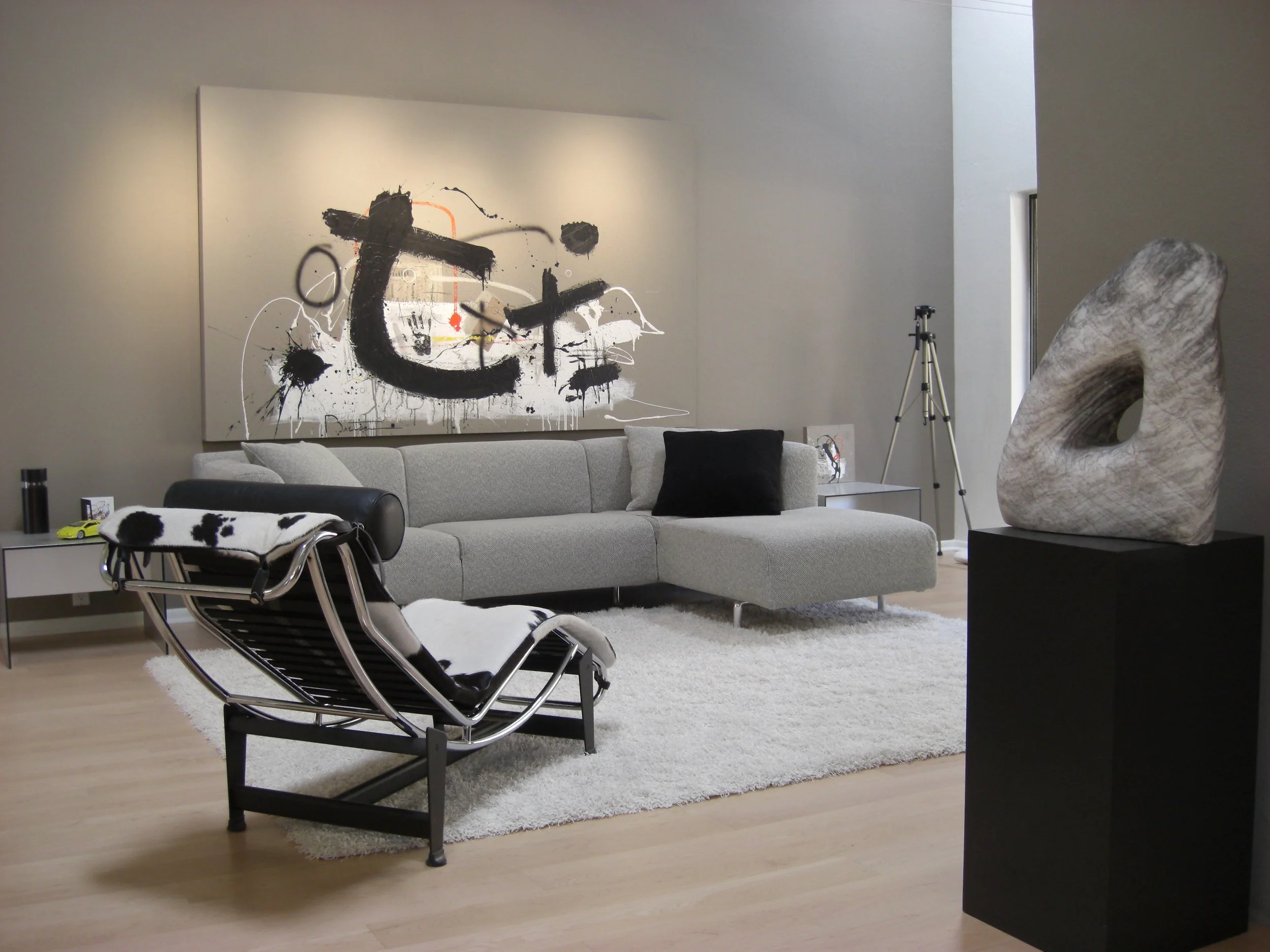
Joseph Bretón builds his work on a foundation of classic modernism, anchoring this composition with dominant, heavy structural gestures that establish an immediate graphic gravity. The piece relies on a deliberate spatial layout, suspending massive, hard-edged marks over an expansive, field of color balanced by an isolated celestial disc and linear geometric pathways.
By integrating sharp scratch-work lines, technical grid elements, and fragmented symbolic text, the physical surface becomes a multi-layered, precise record of immediate, controlled action.
Structural Foundations
A defining mechanic of Bretón's painting is his distinct refusal to acknowledge a conventional outer edge. In this composition, the perimeter functions as a porous boundary rather than a constraint, splitting the field into deep structural planes. Aggressive, visceral sweeps of opaque pigment explode across the lower register, fracturing into erratic paint splatters and kinetic loops that bridge the gap between heavy textured fields and a neutral base.
This specific structural choice integrates raw canvas dynamics, sweeping gestural geometry, and fragmented newsprint collage to remove traditional spatial limits, placing his historical modernist techniques into an open, continuous context.
The Rejection of the Frame
The textures and structural logic of the paintings are directly informed by the physical environments where they are created. Bretón shifts his practice between three primary studios: Santander, Spain; Naples, Italy; and Scottsdale, Arizona. In this piece, a vast, heavily textured field evokes raw environmental scale, serving as the backdrop for an intricate internal layout where aggressive, horizontal slashes of paint intersect with weathered collage fragments and tactile cardboard elements.
Each location introduces distinct variations in coastal light, historic density, and high-desert scale, resulting in a diverse but deeply unified body of work. By anchoring central graphic rings and linear architecture against an atmospheric, monochromatic haze, the canvas mirrors the weathered surfaces and contrasting terrains of his regional studio settings.
Geographic Anchors
Bretón's paintings and works on paper are actively held in private and public collections across the United States and Europe. His exhibition history and collection placements include significant presence in Italy, Spain, Belgium, and Holland. In this composition, monumental, high-contrast gestural strokes dominate the foreground, establishing an immediate structural weight suspended within a expansive, smooth gradient field.
The work relies entirely on its own physical mechanics and visual weight to anchor these contemporary spaces. By anchoring aggressive, intersecting black glyphs and fine, kinetic linework against contrasting structural bands, the canvas commands an authoritative architectural presence suitable for global institutional collections.